Ragweld
Open-source MLOps platform for API-first RAG and agent systems with versioned config, tri-hybrid retrieval, and MCP integration.
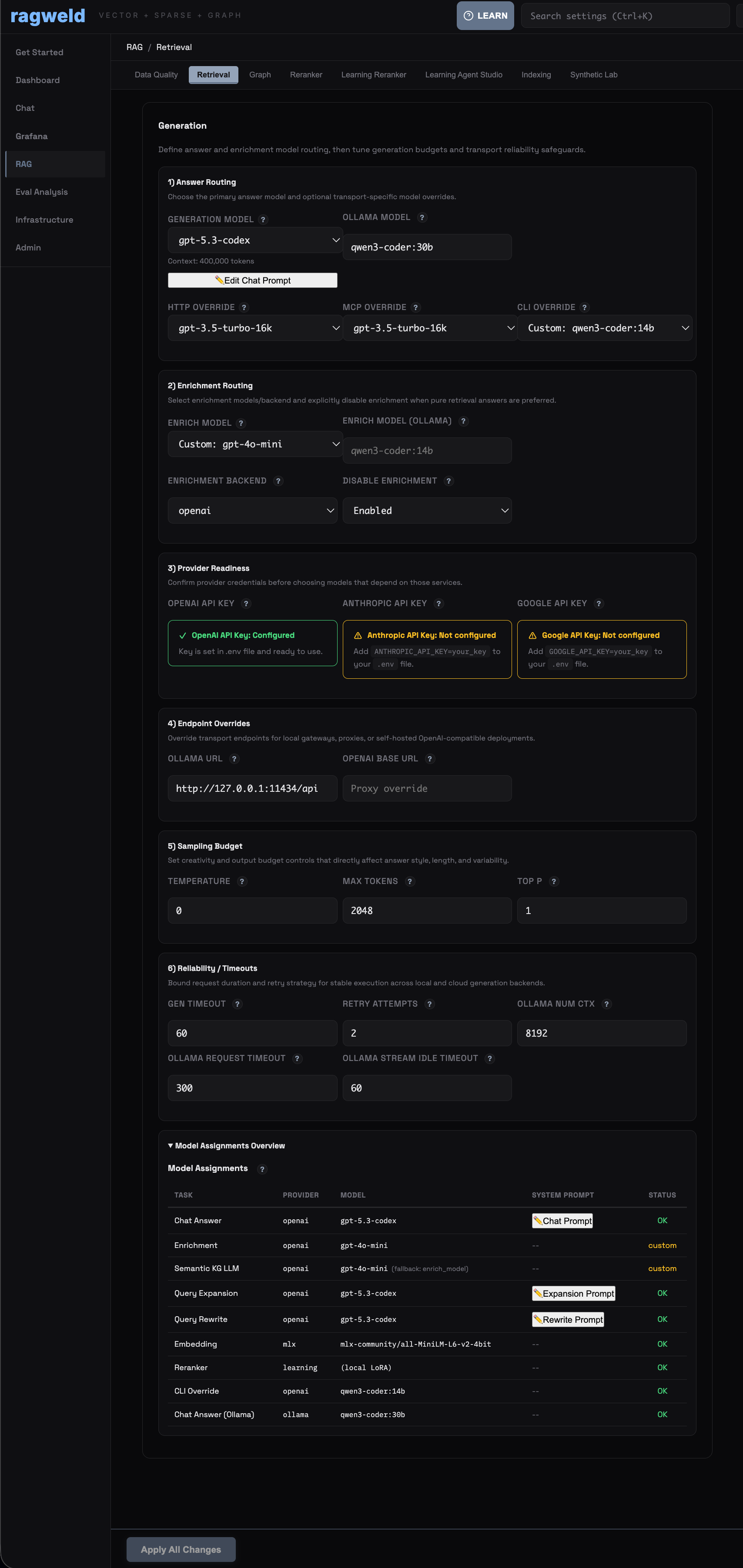
Ragweld is a full-stack MLOps platform for building and operating RAG and agent systems. It runs three retrieval methods in parallel – vector search via pgvector, sparse BM25 search via PostgreSQL full-text search, and graph traversal via Neo4j – then fuses their results with reciprocal rank fusion and optional reranking. The result is a retrieval layer that covers semantic similarity, lexical precision, and relational structure simultaneously.
The platform is API-first, with independent model and provider routing for API, chat, CLI, and MCP channels. All configuration is Pydantic-backed and versioned, with over 500 tunable parameters exposed via both UI and API.
Key Features
- Tri-hybrid retrieval – vector, sparse, and graph search with reciprocal rank fusion
- Embedded MCP server on Streamable HTTP for Claude Desktop and IDE integration
- Dual training studios with checkpoint promote/rollback and run telemetry
- Synthetic Data Lab for eval datasets, semantic cards, and autotune patches
- Knowledge graph with automatic entity extraction and community detection
- Semantic cache with recall gates for cost-efficient repeated queries
- Evaluation workbench with run diffs for A/B comparison across configurations
Technical Architecture
Ragweld’s backend is Python/FastAPI with PostgreSQL (pgvector for embeddings, FTS for sparse retrieval) and Neo4j for the knowledge graph layer. The frontend is React/TypeScript. Observability is built in through Grafana and Loki integration, with tracing across the full retrieval and generation pipeline.
Training workflows use manifest-backed artifact management with provenance tracking. The Synthetic Data Lab generates evaluation datasets and autotune patches, feeding into the dual training studios where operators can fine-tune both a learning reranker and an in-product agent model. All training runs are instrumented with telemetry for reproducibility.
The platform ships 500+ config parameters, but operators interact with them through sensible defaults and progressive disclosure – you only touch what you need to.